Lifting, carrying, bending, gripping, reaching, pushing and pulling — each rated Never, Rarely, Occasionally, Frequently or Constantly.

Injury Prevention
Job Dictionary
Under the Health and Safety at Work Act 2015, New Zealand businesses have a primary duty of care to eliminate or minimise risks to their workers’ health and safety. Under the Act, “health” means mental health as well as physical. A Job Dictionary is one of the most practical tools available to meet both obligations.
A Job Dictionary is a documented, on-site record of the inherent requirements & demands of a role – physically, psychologically and cognitively
It turns an abstract legal duty into something concrete, defensible and actionable.
It provides objective data about your roles so you can make better decisions around who you hire, how you manage risk, and how you support your people.
Identify and manage workplace risk
Match worker capacity to job demands
Support safer return-to-work decisions
Strengthen proactive injury prevention
Meet workplace health and safety obligations
role demand breakdown
What Does a Job Dictionary Capture?
A Job Dictionary documents the physical and psychosocial demands of a role. Here’s what that includes:
Physical

Task outline
A breakdown of every task in a shift — what workers do, in what order, and how long each takes. Onsite photos support the detail.

Critical physical demands

Work demand classification
Each role is rated Sedentary, Light, Medium, Heavy or Very Heavy against a standardised scale. This supports pre-employment screening.

Range of motion requirements
Specific degrees of movement required at key joints, including the lumbar spine, shoulders and knees, to perform the role safely.

Objective physical testing standards
Minimum grip strength, lift capacity, push/pull force and functional movement standards a worker must meet for the role.

Environmental & shift factors
Shift duration, breaks, PPE requirements, task rotation cycles, workspace constraints and environmental hazards.
Psychological & cognitive

Psychosocial demands
Autonomy, deadline pressure, stress, accountability and exposure to difficult situations — documenting the psychological conditions of the role.

Cognitive demands
Attention, memory, safety judgement, problem solving and multitasking — rated by frequency and described in the context of the role, especially for safety-critical work and return-to-work planning.
Understanding Injury Risk
Why the Physical Demand Classification Matters
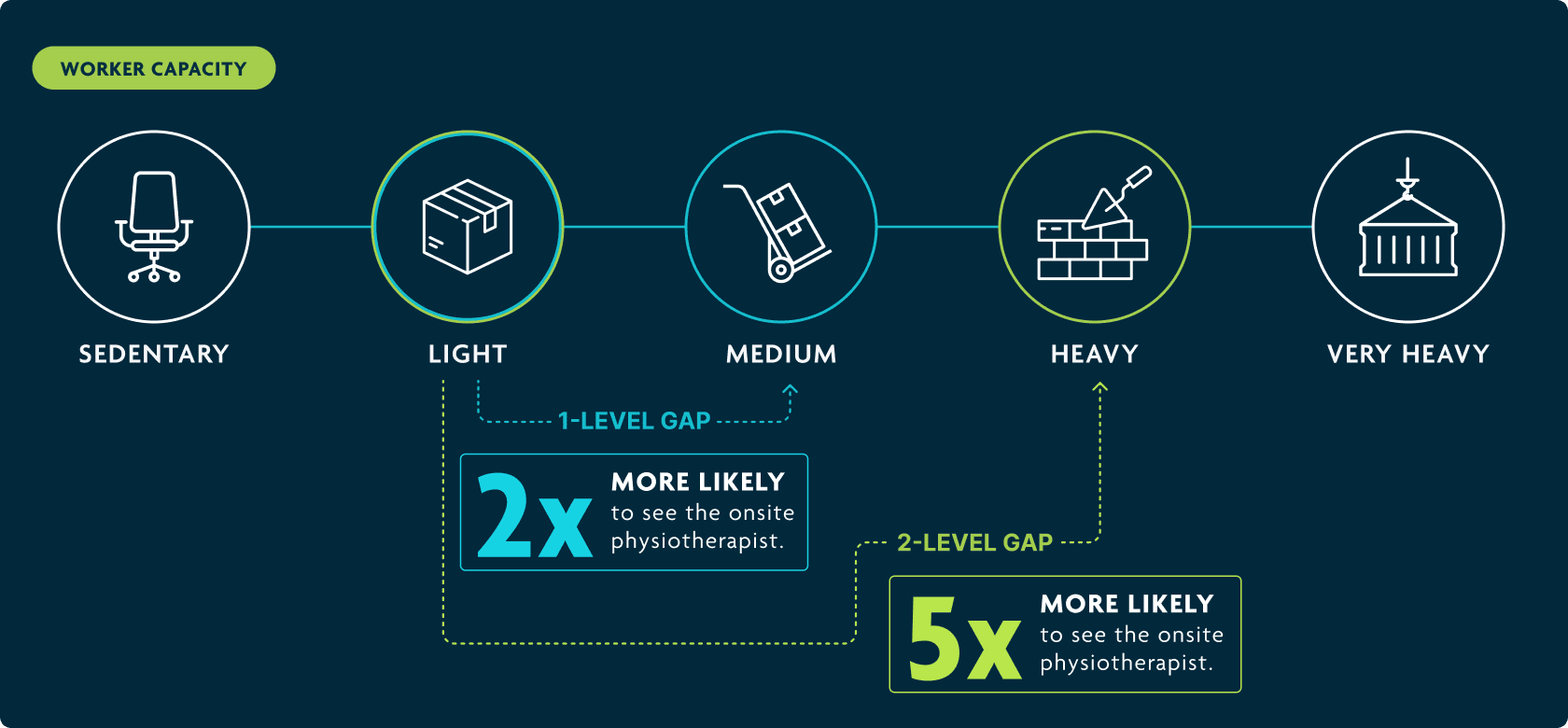
Every role documented in a Job Dictionary is classified using the Dictionary of Occupational Titles (DOT). It’s a standardised framework that defines physical work demand levels from Sedentary through to Very Heavy. This classification is how we measure risk. When a worker’s physical capacity is lower than the demand rating of their role, they are operating beyond what their body can safely sustain.

Key takeaway
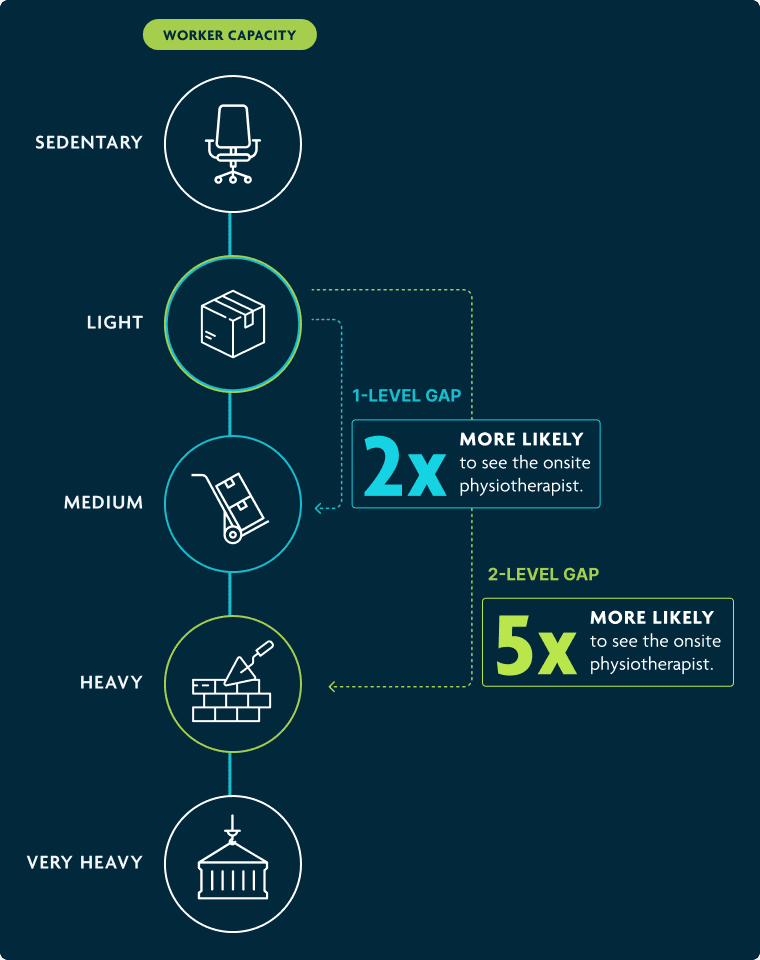
Workers placed in a job one level above their physical capacity are 2x more likely to see the onsite physiotherapist. Workers placed in a job two levels above their capacity are 5x more likely. A Light-capacity worker placed in a Heavy role is a predictable pathway to injury.
That’s not a small margin. The DOT classification for each job becomes a reference point your business relies on across pre-employment screening, return to work and proactive injury prevention.
FROM INSIGHT TO ACTION
Under the Health and Safety at Work Act 2015, you’re required to identify hazards and eliminate or minimise risks so far as is reasonably practicable. This is where a Job Dictionary becomes part of a bigger solution.

Assess the risk
Where the Job Dictionary documents the inherent requirements of a role, a Manual Task Risk Assessment (ManTRA) formally assesses where the risk sits — documenting hazards, evaluating likelihood and consequence, and identifying the controls required.
Together, they help demonstrate your business has met its legislative duty of care.

Assess worker capacity
Once a role is classified and its risks are assessed, you need to know whether the person filling it can meet those demands.
Through Pre-Employment Screening, we physically assess each candidate and assign a capacity rating: Sedentary, Light, Medium, Heavy, or Very Heavy.

Match capacity to the role
We cross-reference each candidate’s capacity rating against the Job Dictionary for their role.
The result is a clear, objective view of fit and a defensible, documented rationale for placement decisions.
It’s about placing the right person in the right role and knowing the risk when there’s a gap.
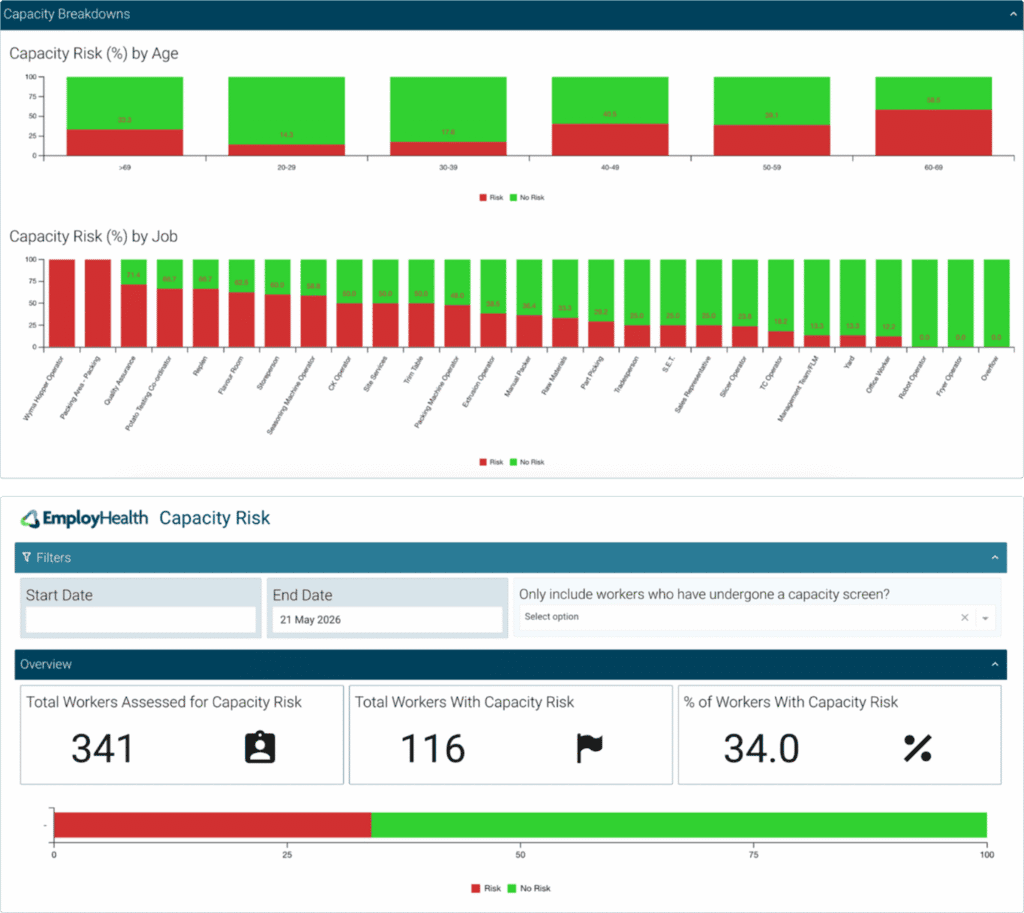
The Capacity Risk dashboard provides a clear, real-time view of capacity mismatches across your workforce, helping you identify where injury risk is highest and make more informed decisions.
The Job Dictionary Is the Starting Point
Most workplace injury prevention starts with identifying what the job actually demands. A Job Dictionary gives you that foundation.
Here’s how it connects to everything else:

Pre-Employment Screening
Once you know what a job demands, you can screen candidates against those demands. We assess each candidate’s capacity and compare it directly to your Job Dictionary.

Manual Task Risk Assessment (ManTRA)
A Job Dictionary identifies what a role demands. ManTRA assesses the risks, documents hazards and identifies the controls required to meet your workplace health and safety obligations. Together, they form the evidence base that demonstrates your business has met its duty of care under the Work Health and Safety Act 2011.

Capacity Matching
The physical rating from a Pre-Employment Screen is matched to the physical rating of the role. Make sure the worker is fit enough to perform the physical demands of the role.

Early Intervention Physiotherapy
When Job Dictionaries highlight high-risk demands like heavy lifting, constant gripping or repetitive bending, Early Intervention targets workers in those roles before minor discomfort becomes a WorkCover claim.

Onsite Physiotherapy
Your Job Dictionary gives your onsite physio team context. When they’re treating a worker, they can see exactly what that role demands and what the worker needs to return to safely.

Rapid Response (on-call triage within an hour)
When an injury occurs, your Job Dictionary gives our Rapid Response team immediate context about the role’s demands, helping guide clinical triage and safe modified duties from day one.

Dynamic Warm-Up & Stretch Programs
By documenting the muscles and movements each role demands, Job Dictionaries help create targeted warm-up and stretch programs tailored to the job, rather than generic routines.

Workplace Psychosocial Risk Assessment
Your Job Dictionary documents each role’s psychosocial demands. A formal assessment goes further, identifying the highest risks across your business and the controls needed to meet legislative obligations.

Movewell™ Training
Your Job Dictionary identifies where manual handling risk is highest. Movewell™ uses that insight to deliver role-specific training built around the actual physical demands of the job.
Part of the Job Hub
A Job Dictionary is just the starting point. Employ Health’s Job Hub is a systematic approach to workplace risk management and brings together your Job Dictionaries, Manual Task Risk Assessments, PErforM reports and job ratings into one connected platform.
No more hunting through spreadsheets or shared drives. Just a clear, evidence-based picture of the health and safety risks across your entire workforce. A Job Dictionary is where it starts. The Job Hub is where it lives.
Why Employ Health
Why Businesses Trust Employ Health

We do this in the workplace, not off a questionnaire.
Our physios go onsite to observe tasks, take photos, measure loads and talk directly to workers. The result is an accurate, defensible record; not a manager’s best guess from a meeting room.

Everything lives in your Job Hub, accessible to your team.
Accessible to your WHS, operations and HR teams from anywhere, always up to date. All completed Job Dictionaries are stored in one secure, centralised hub, giving everyone access to the same information.

It integrates with your other health data.
Our platform connects Job Dictionaries with pre-employment screening results, physiotherapy records and injury data. No more managing separate spreadsheets — just one connected picture of workforce health.

We’ve worked across different industries.
Construction, manufacturing, food processing, mining, transport, healthcare. The physical demands vary enormously across these environments – and so does our approach. We don’t copy and paste. We assess each role on-site.

ISO 45001 & ISO 9001 Certified
Independently certified for safety and quality management. That matters when your Job Dictionary is being relied on to make employment and return-to-work decision
Ready to build your Job Dictionary?
Whether you’re documenting job demands for the first time or looking to improve your existing approach, we can help.
Let’s build a safer workplace, starting with a clearer understanding of every role.
Frequently Asked Questions
What is a Job Dictionary in the workplace?
A Job Dictionary is an on-site documented record of the inherent physical and psychosocial demands required to safely perform a specific role. It covers task breakdown, physical movement frequency, load requirements, range of motion, environmental factors and the objective testing standards a worker must meet. A complete Job Dictionary also captures psychosocial and cognitive demands, including stress exposure, autonomy, safety judgment and attention requirements. It’s sometimes called a Job Task Analysis.
Is a Job Dictionary a legal requirement in New Zealand?
A Job Dictionary isn’t required by name. However, it helps businesses meet their obligations under the Health and Safety at Work Act 2015. As a PCBU, you have a primary duty of care to ensure, so far as is reasonably practicable, the health and safety of your workers. That means identifying hazards such as manual handling and eliminating or minimising the risks. A Job Dictionary documents the inherent physical requirements of the work performed, and a Manual Task Risk Assessment (ManTRA) formally assesses the risk. Together they give you a documented, defensible record of how you’re managing manual handling risk.
A Job Dictionary also supports the ACC process. When a worker is injured, it gives the treating clinician and ACC an objective picture of the role. That makes it easier to plan suitable duties, support rehabilitation and achieve a timely return to work.
Under Workers’ Compensation legislation, a Job Dictionary assists employers in meeting their responsibilities to provide suitable duties, facilitate rehabilitation and support timely return to work.
Does a Job Dictionary cover psychosocial and cognitive demands?
Yes. A complete Employ Health Job Dictionary documents both the physical and psychosocial demands of a role. This includes degree of autonomy, deadline pressures, stress exposure, accountability requirements and cognitive demands such as attention, safety judgment and problem solving. Each factor is rated by frequency and contributes to an overall psychosocial risk score. This gives you an objective, documented profile that supports your obligations under the Health and Safety at Work Act 2015, which covers mental health as well as physical health, and aligns with WorkSafe’s guidance on managing psychosocial risks.
What is a Manual Task Risk Assessment (ManTRA) and do I need one?
A ManTRA formally assesses the risk of hazardous manual tasks in your workplace. It documents hazards, evaluates likelihood and consequence, and identifies the controls required. Under the Health and Safety at Work Act 2015, you must identify hazards and eliminate or minimise risks so far as is reasonably practicable. Completing a ManTRA alongside your Job Dictionary is one of the clearest ways to document that you’ve done so. Together they form the evidence base that demonstrates your business has met its duty of care.
ManTRA is a widely used, evidence-based tool for assessing manual task risk.
What is Capacity Matching and how does it relate to a Job Dictionary?
Capacity Matching is the process of comparing a worker’s assessed physical capacity against the job demands documented in a Job Dictionary. Workers are assessed and rated on a physical demand scale (Sedentary, Light, Medium, Heavy, Very Heavy), and that rating is matched to the role’s classification. Our data shows workers placed one level above their capacity are 2x more likely to require physiotherapy. Two levels above = 5x more likely.
Can a Job Dictionary be used in the return-to-work process?
Yes! And it’s one of the most practical applications. When a worker is recovering from an injury, their treating doctor needs to understand what the role actually demands before clearing them to return. A Job Dictionary provides that documentation objectively, supporting better, safer return-to-work decisions.
Does Employ Health complete Job Dictionaries on-site?
Yes. Our team attends your workplace, observes the role being performed, documents the demands and photographs the tasks. This is not a desktop exercise. The accuracy of a Job Dictionary depends on seeing the job as it’s actually done.
Find Out More
Tell us a little about your workplace and one of our specialists will be in touch to discuss the best options for your team.
"*" indicates required fields